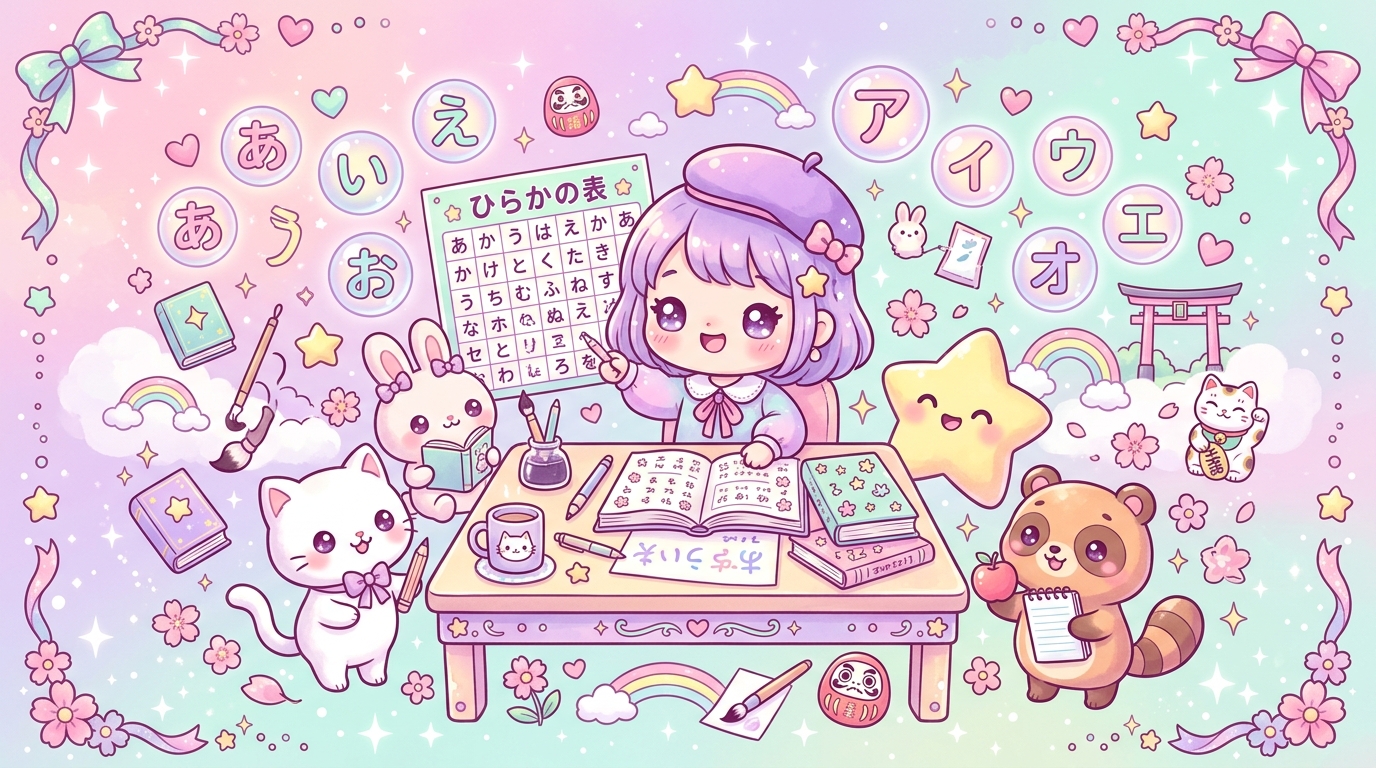
Have you always dreamed of mastering the language of Miyazaki and Hello Kitty, but find austere textbooks make your head spin? What if I told you that the key to unlocking your progress lies in your set of felt-tip pens and your love for adorable little characters? Welcome to the wonderful world of kawaii Japanese learning, a gentle, colorful, and incredibly effective approach to mastering this fascinating language without ever feeling the pressure of traditional rote memorization.
The concept is simple: when our brain is stimulated by cute visuals, it produces dopamine, which makes memorization not only easier, but above all much more joyful! Get your pencils ready; we are going to turn your study sessions into a true moment of creative relaxation.
Why the Kawaii Style is Your Best Ally for Mastering Japanese
Learning a foreign language is often seen as a tedious chore. However, by incorporating kawaii Japanese learning into your routine, you completely change the game. The "kawaii" style (cute in Japanese) is not limited to drawings of cats with round eyes; it is a philosophy that values kindness, simplicity, and joy. By associating these positive emotions with your new words, you create powerful mnemonic anchors.
Kawaii is not just an aesthetic; it is a learning method that transforms effort into pure pleasure.
Why does this method work so well? Here are a few reasons:
- Stress reduction: Coloring is a meditative activity that calms the anxiety associated with learning.
- Visual stimulation: Our memory retains a colorful image much better than a list of black words on a white background.
- Playful approach: By making Japanese learning fun, you turn your work sessions into a creative appointment you’ll look forward to.
The Magic of Images: Associate Every Word with an Irresistible Illustration
Human memory is deeply visual. To enrich your cute Japanese vocabulary, don't just translate words; bring them to life! Imagine you are learning the word "Neko" (cat). Instead of writing it a hundred times, draw a little kitten with pink cheeks and write "Neko" next to it. Your brain won’t just retain a word; it will retain a scene, an emotion, and a shape.
How to Transform Your Notebook into a Kawaii Collection
To succeed in your kawaii Japanese learning, start by choosing one theme per week: fruits, animals, everyday objects. For each word, draw a "chibi" (miniature) version of the object. The goal is not to become a professional artist, but to create an emotional connection with each new term.
The Pillars of Cute Japanese Vocabulary
To get started, focus on words that lend themselves wonderfully to drawing:
- Hoshi (star): Draw a little smiling star with sparkles.
- Ichigo (strawberry): A strawberry with tiny closed eyes and a peaceful expression.
- Kuma (bear): A round little bear with a small scarf.
Create Your Own DIY Flashcards: The Art of Memorizing While Having Fun
Flashcards are a classic tool, but let's be honest: they are often boring. By creating your own illustrated cards, you shift from passive learning to an active process. This is where coloring and languages meet to form the perfect duo.
Essential Materials for Your Cards
Nothing complex! You just need cardstock, fine-tip markers for details, and pastel colored pencils for a soft touch. The principle is simple:
- Front: The kawaii drawing of the object.
- Back: The word in hiragana, its transcription in romaji, and its English translation.
By handling these cards you’ve decorated yourself, you reinforce kinesthetic memory. Coloring each card allows your mind to focus on the word while your hand draws, creating a double memorization effect that is highly effective for kawaii Japanese learning.
Practical Exercise: Anchoring Kanjis and Hiraganas in Your Memory Through Coloring
The Japanese writing system can seem intimidating at first. But have you ever tried turning a character into a drawing? It's a brilliant technique for learning Japanese in a fun way. For example, the kanji for "mountain" (山) already looks like a natural shape; by coloring it and adding small kawaii trees around it, it becomes impossible to forget.
Tips for Practicing Coloring and Languages
Coloring and languages isn't just for relaxing; it's a genuine study tool. Here is how to structure a session:
- Choose a thematic coloring page (for example, a picnic scene).
- Identify the objects in the scene and look up their names in Japanese.
- Write the corresponding hiraganas on the objects in the drawing.
- Color the entire page while repeating the word out loud every time you change colors.
"Repetition is the mother of mastery, but creativity is its soul."
By associating the tracing of characters with a coloring activity, you remove the rigid, academic side. You learn the structure of the strokes while having fun with textures and shades.
Start Your Linguistic Adventure with Our Exclusive Sheets!
Are you ready to turn your Japanese studies into a gentle and sparkling experience? Kawaii Japanese learning is waiting for you! It’s time to leave behind the austere textbooks for a notebook filled with colors, little characters, and joy.
To help you with your first steps, we have prepared a special collection of coloring-vocabulary sheets. Each illustration is designed to help you memorize your first words while letting your creativity run wild. Whether you are a complete beginner or just want to enrich your cute Japanese vocabulary, these resources are made for you.
Ready to color your way to Japanese mastery? Click below to download our thematic sheets for free and start learning with a smile today!
[Link: Download my Kawaii Learning Kit]