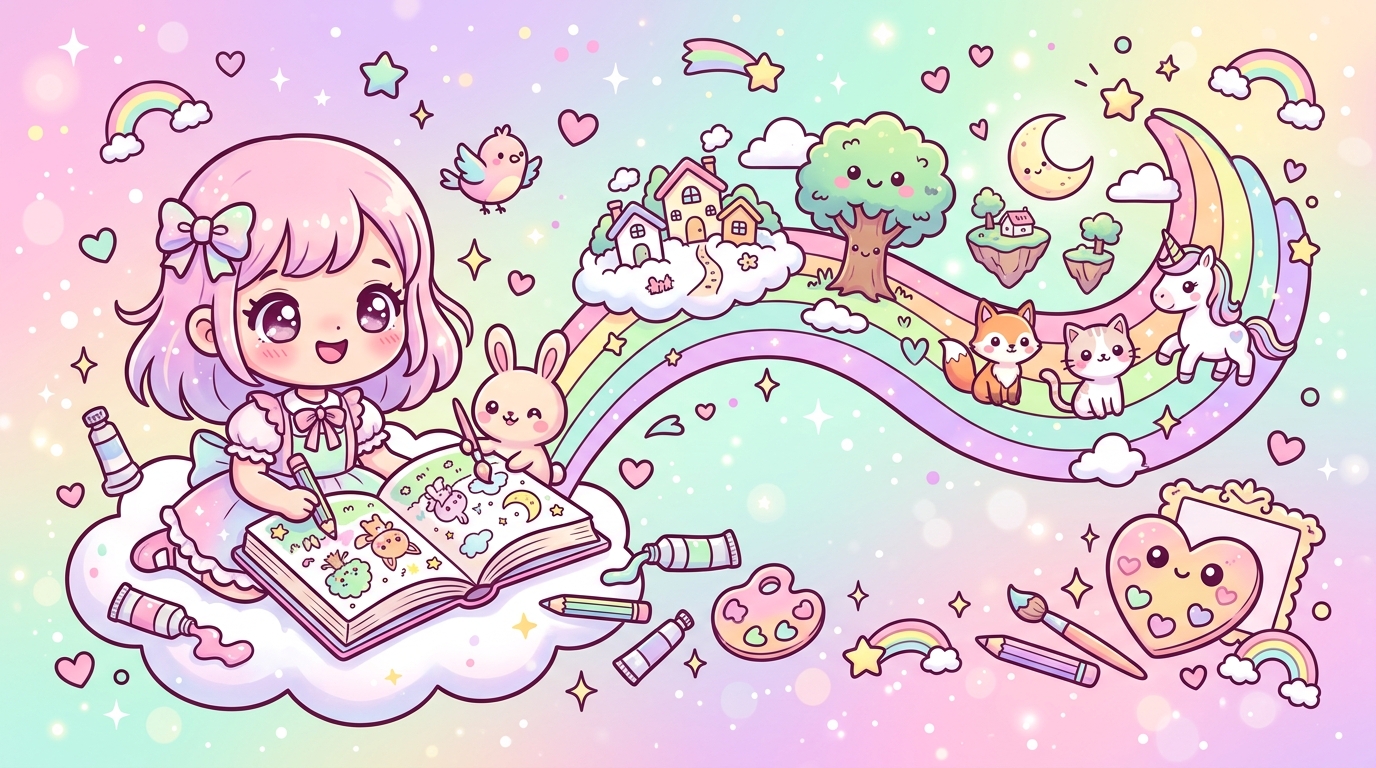
You love coloring those little characters with their big, sparkling eyes and rosy cheeks, don't you? There is something so soothing about the kawaii universe. But have you ever wanted to take it a step further? Imagine if your greedy little kitten or your smiling cloud didn't just "pose" on the page, but lived out a real adventure. That’s where the narrative kawaii scene comes in: the art of turning a simple drawing into a little story that you tell with your markers and pencils.
Moving from a single character to a full scene is like opening a window onto a magical world. Instead of just filling in color zones, you become the director of your own little animated film on paper. In this article, we will explore how to breathe life into your illustrations to make your coloring pages vibrate with new emotion.
Bring Your Drawings to Life: Why Switch to Narrative Kawaii Scenes?
Coloring is a relaxing activity, but the narrative kawaii scene adds an extra creative dimension that stimulates your imagination. When you create a story around your characters, you are no longer just filling in space: you are building a universe.
- A deeper connection: By imagining why your character is there, you become more attached to your drawing.
- A stimulating creative challenge: You learn to structure space and choose elements that support your narrative.
- A more rewarding result: A page that tells a story is much more impressive to display than a simple isolated motif!
By learning to tell a story through drawing, you turn every coloring session into a moment of total escape where time stands still.
The Secrets of a Composition That Transports You
Kawaii coloring composition is the foundation of your narrative. For a scene to be readable and lively, it is not enough to just add objects at random. You must create a path for the viewer's eye to follow.
The Golden Rule: The Focal Point
In any good narrative kawaii scene, there must be a main character or object that catches the eye first. Place it slightly off-center to give the whole piece dynamism. Around it, arrange secondary elements that explain the "why" of the drawing.
Using the Background to Set the Context
To succeed in your kawaii staging, ask yourself: "Where is my character?".
"A character alone is an image; a character surrounded by objects is a story."
If your little character is eating ice cream, add melting drips falling, a little bird watching with envy, or flowers dancing around. These simple details transform a static pose into a vibrant moment of life.
Emotions and Interactions: The Heartbeat of Your Story
The Japanese style is all about expression. To tell a story through drawing, your characters must interact with their environment. Kawaii excels at the art of showing pure emotions: joy, surprise, shyness, or excitement.
Making Your Characters Interact
If you are coloring a scene with two characters, create a bond between them. A shared look, a reaching hand, or an object they are sharing immediately creates narrative tension. They are no longer two drawings side by side; they become traveling companions.
The Importance of the "Little Things"
In kawaii staging, accessories are king. A little heart above a head, a sweat drop (for embarrassment), or little stars (for wonder) are powerful narrative tools. They allow the viewer to understand the character's state of mind without needing to write a single word.
Harmonizing Colors to Enhance Your Narrative
Color isn't just there to look pretty; it serves to set a mood. This is where your kawaii coloring composition takes on its full emotional dimension. To succeed in a narrative kawaii scene, visual unity is paramount.
Choosing a Narrative Palette
If you want to tell a story of a sunny morning, use bright pastels: lemon yellow, sky blue, candy pink. If your story takes place during a cozy evening, opt for warmer tones like purple, soft orange, and midnight blue.
The Gradient Trick to Add Volume
So that your character doesn't look "flat," use simple gradient techniques. Apply a darker color to the shadowed areas (under the arms, behind objects) and leave a very light area for the light source. This depth allows the character to "pop" off the page and truly integrate into their surroundings.
Creating Connections Through Color
To ensure your drawing forms a coherent whole, don't hesitate to echo a color present on the character within the background elements. For example, if your little bear is wearing a blue scarf, add a few blue flowers in the background. This guides the viewer's eye throughout the entire scene.
Your Turn: Become the Storyteller of Your Own Coloring Pages!
You now have all the keys to transform your moments of relaxation into true artistic creations. The narrative kawaii scene is not about perfect technique, but about the joy of imagining wonderful worlds. Every pencil stroke is a new adventure for your favorite characters.
Don't be afraid to experiment! Add accessories, change the backgrounds, and above all, let your heart speak. It is by daring that you will develop your own narrative style.
Want to put these tips into practice right now? We have selected an exclusive collection of coloring pages designed to inspire your most beautiful stories. Whether you are a fan of adventurous little animals or greedy magical creatures, you will find plenty on our site to feed your imagination.
Join our community of enthusiasts! Share your creations on social media with our dedicated hashtag and show us how you tell your universe. Discover our new kawaii coloring templates now and begin your next great creative adventure!